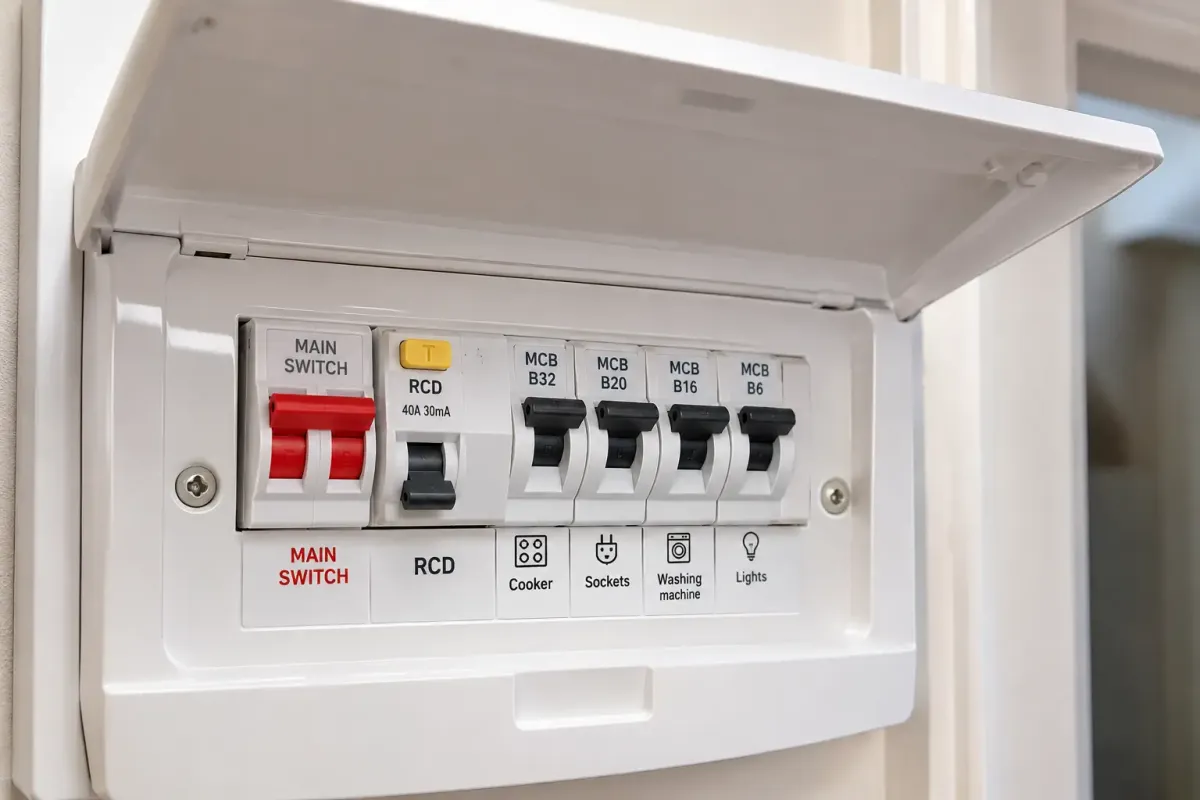
The consumer unit is the box where the electricity in your home is controlled and shared out to each circuit. You may know it as the fuse box, the fuse board or the distribution board. It holds the main switch, the circuit breakers or fuses for each circuit, and the RCDs that protect you from electric shock. Electrical Safety First advises knowing where yours is, so you can turn the power off quickly in an emergency.
This guide explains what each part does, how to tell an older board from a modern one, and what the rules say when a consumer unit is replaced.
What is inside a consumer unit
The main switch
The main switch turns off the electricity supply to the whole home. Some homes have more than one. It is there to isolate the installation, not to protect it: it gives no electrical protection on its own, but it is the switch to use in an emergency, for example if someone is receiving an electric shock.
Circuit breakers and fuses
Each circuit in the home, such as the cooker, the shower, the sockets or the lights, has its own circuit breaker or fuse. These protect against overcurrent and short circuits. If a circuit draws too much current, or a fault causes a short circuit, the breaker switches that circuit off. Breakers are rated in amps.
Circuit breakers are the modern replacement for fuses. Electrical Safety First points out that they give more precise protection and can simply be reset once the fault has been corrected, where an older rewireable fuse has to be repaired by hand.
RCDs
An RCD, or residual current device, watches the current flowing in the circuits it protects. If it detects electricity going somewhere it should not, such as through a person who has touched a live part, it switches the circuit off very quickly. That greatly reduces the risk of death or serious injury. RCDs are rated in milliamps, which makes them thousands of times more sensitive than a circuit breaker or fuse.
A common arrangement in a home is two RCDs, each covering a group of circuits, so that if one trips the circuits on the other keep working. Lighting is often split between them, upstairs and downstairs, so a trip does not leave the whole house in the dark. Some consumer units use RCBOs instead, which combine an RCD and a circuit breaker in one device for each circuit.
Other parts of a modern unit
The IET lists several other parts you may see in a current consumer unit: blanking pieces that close off unused spaces so live parts cannot be reached, circuit labels, a surge protective device (SPD) and, in some cases, an arc fault detection device (AFDD). The wiring regulations recommend AFDDs rather than requiring them. If you can see a gap in the front of your consumer unit big enough to fit a finger into, the IET advises getting it looked at.
How to tell an old fuse box from a modern consumer unit
Older homes often still have the board that was fitted when the house was wired. In the 1960s it was acceptable to install a unit on a wooden backboard, usually with rewireable fuses. Electrical Safety First says a consumer unit should have a main switch and fuses or circuit breakers, and should not have a wooden back, cast-iron switches or a mixture of different makes of device.
An older unit without RCDs or circuit breakers is not automatically unsafe, and it does not automatically need replacing. An EICR will tell you whether it is still safe to use. Where there is no RCD protection, the report is likely to recommend an upgrade to meet the current standard, coded C3, which means recommended but not urgent. Read more in our guide to what an EICR is.
Metal consumer units and surge protection
Since January 2016, consumer units in homes have had to be made of non-combustible material, or be housed inside a cabinet made of it. In practice that means a metal enclosure. The rule came in with Amendment 3 to the 17th Edition of the wiring regulations and carries on in the current 18th Edition. The aim is to contain a fire if one starts inside the unit. White plastic units, like the one in the photo above, are what many homes still have from before that date.
The 18th Edition also requires protection against surges in single homes, unless the value of the installation and the equipment in it does not justify it. That is why a surge protective device is now a common part of a new consumer unit.
Replacing a consumer unit: what the rules say
In England, replacing a consumer unit is notifiable work under Part P of the Building Regulations. That means it has to be signed off in one of two ways:
- by a registered electrician. An electrician registered with a competent person scheme, such as NICEIC or NAPIT, can self-certify the work, so you do not have to notify building control yourself.
- through building control. If the electrician is not registered, building control must be told before the work starts.
After the job you should be given an Electrical Installation Certificate and a Building Regulations Compliance Certificate. Electrical Safety First says to ask for both; being “registered online” is not a substitute for the certificate itself. The compliance certificate should reach you within 30 days. Keep them with your house documents, because GOV.UK warns that without the right approval you may not have the certificates you need when you sell.
Warning signs to act on
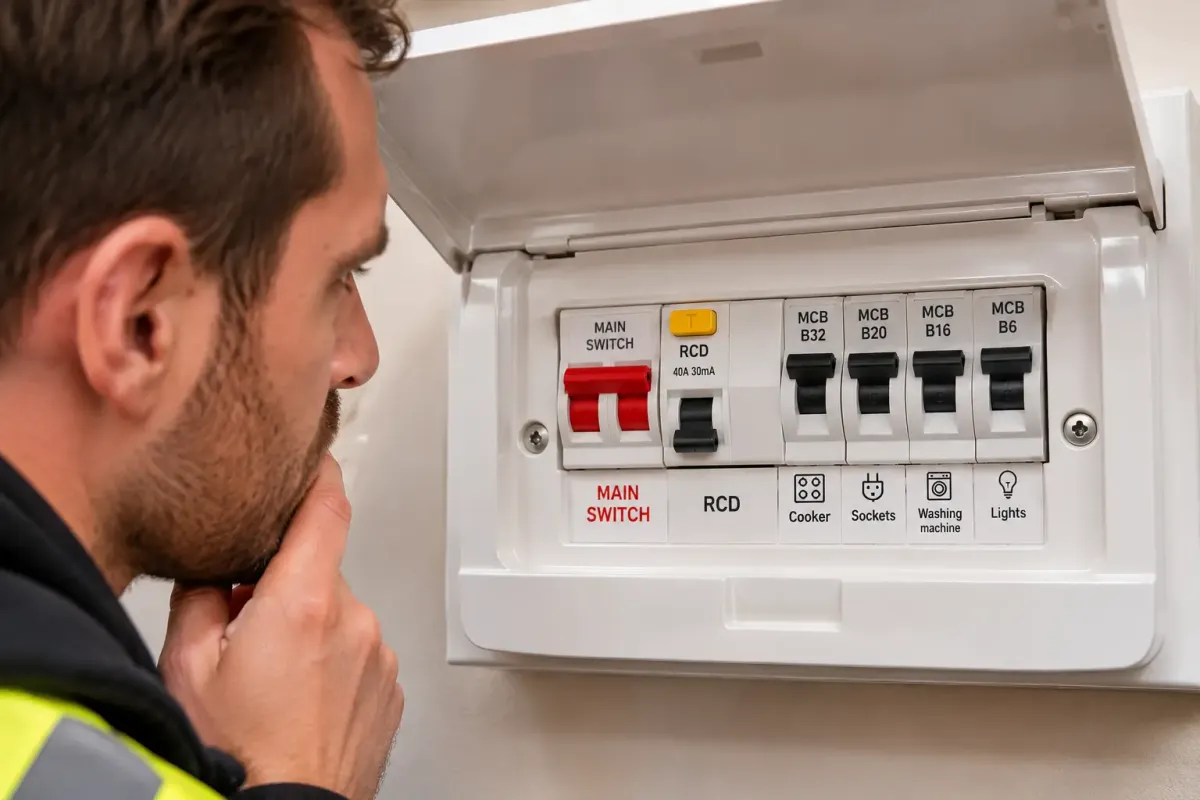
The IET says that if you notice a burning smell, too much heat, smoke, or burning or charring at the consumer unit, you should switch off the supply straight away and call a registered electrician. After a flood, Electrical Safety First advises getting a registered electrician to check it if there is any sign of water inside the unit. And if a breaker or RCD keeps tripping, see our guide to why a circuit breaker keeps tripping.
Electrical Safety First also recommends testing your RCDs regularly. Press the button marked “T” or “Test”: the RCD should switch off the circuits it protects, and you can then switch it back on. If it does not switch off, call a registered electrician.
Finding an electrician in Surrey
The consumer unit and fuse board replacement page lists every electrician in this directory whose own website says they replace or upgrade consumer units, ranked by Google rating and number of reviews. You can also open any town page and filter by the same service.
England has no licence for electricians, so the thing to check is registration. Look the firm up on the Electrical Competent Person register before you book. Where a listing here mentions a scheme, the business says so on its own website, and we do not verify it.
Sources
- https://www.electricalsafetyfirst.org.uk/news-and-insights/electricity-made-easy/
- https://electrical.theiet.org/courses-resources-and-career-for-electrical-professionals/free-resources/consumer-guidance/consumer-units/
- https://electrical.theiet.org/bs-7671-18th-edition-wiring-regulations/faqs/consumer-units-and-protective-devices-faqs/
- https://www.electricalsafetyfirst.org.uk/safety-advice/home-and-people/home-buyers/
- https://www.electricalsafetyfirst.org.uk/safety-advice/your-questions-answered/
- https://www.legislation.gov.uk/uksi/2010/2214/regulation/12
- https://www.planningportal.co.uk/permission/common-projects/electrics/building-regulations-general-information
- https://www.gov.uk/building-regulations-approval/when-you-need-approval