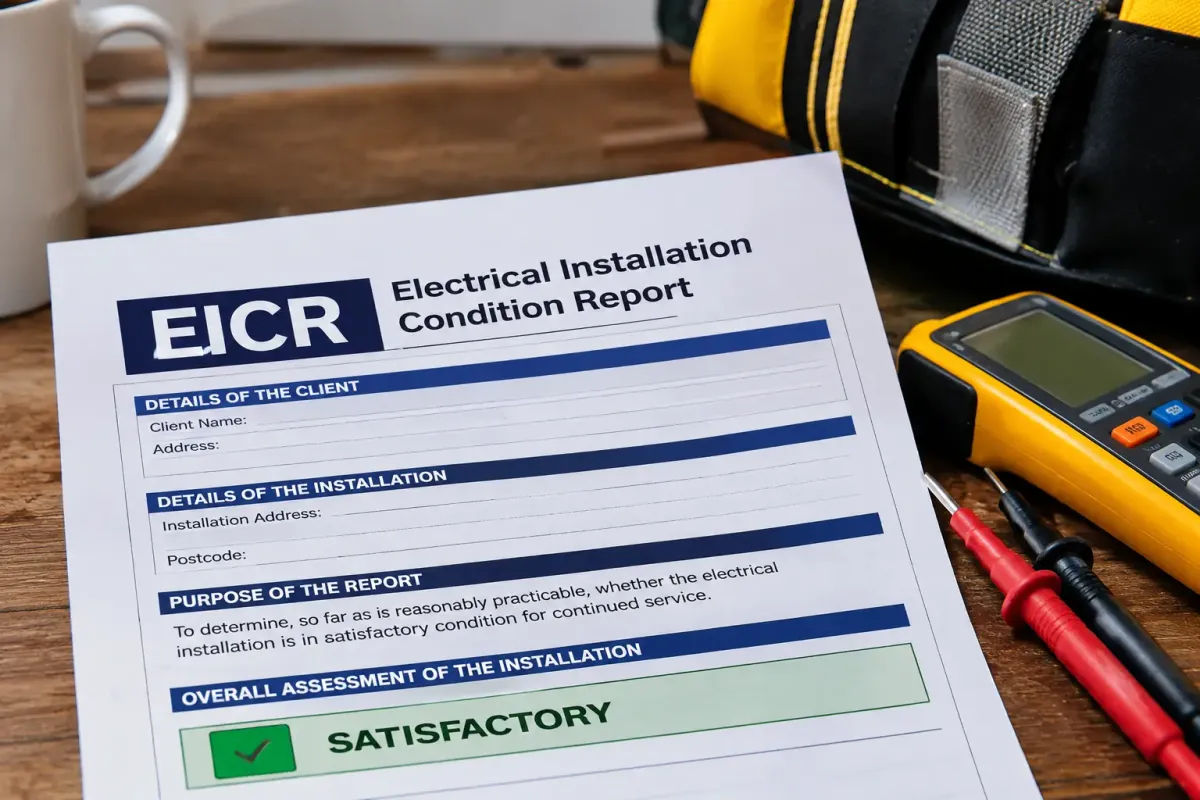
An EICR, or Electrical Installation Condition Report, is the report an electrician writes after inspecting and testing the fixed wiring in a property. It records what they found, flags anything unsafe and sets a date for the next inspection. If you let a home in England, you need one by law. If you own the home you live in, it is a sensible check rather than a legal duty.
This guide explains what the report covers, what the codes mean, who needs one and how to find someone in Surrey to carry it out.
What an EICR looks at
An EICR is about the electrical installation, not the things you plug into it. That means the consumer unit, the circuits, the wiring, the sockets, switches and light fittings, and the earthing and bonding that keep the installation safe if something goes wrong. The person carrying it out inspects what they can see and tests the circuits with specialist instruments, then writes up the results.
The report is measured against BS 7671, the IET Wiring Regulations. BS 7671 is the national standard for electrical installations in the UK. It is not a law in itself, but it is the benchmark an electrician works to. The current edition is BS 7671:2018+A4:2026, the 18th Edition with Amendment 4, which replaced the previous version on 15 October 2026.
An EICR is different from the certificates you get after new work. An Electrical Installation Certificate is issued for a new installation, an addition or an alteration, and a Minor Works Certificate covers smaller jobs that do not add a new circuit. An EICR is for an installation that is already there.
What the codes on an EICR mean
Anything the inspector finds wrong is given a code. The codes tell you how serious it is:
- C1: danger present. There is a risk of injury now and it needs putting right straight away.
- C2: potentially dangerous. Not an immediate danger, but it could become one and needs remedial work.
- FI: further investigation required. The inspector could not reach a conclusion and something needs looking at more closely.
- C3: improvement recommended. The installation does not meet the current standard in some way, but it is not unsafe. This is advice, not a fault that has to be fixed.
If the report finds anything coded C1 or C2, it declares the installation unsatisfactory and remedial work is needed. A report with only C3 items is still satisfactory. In a rented home, C1 and C2 items must be put right, and anything marked FI needs investigating. The inspector may make a C1 hazard safe before they leave.
Do landlords need an EICR?
Yes. Under the Electrical Safety Standards in the Private Rented Sector (England) Regulations 2020, a landlord must have the electrical installation inspected and tested by a qualified person at least every five years, or sooner if the last report says so. Since a 2025 amendment, the same duty covers the social rented sector as well as private landlords.
The rules also set out who gets a copy of the report and when:
- each existing tenant within 28 days of the inspection
- a new tenant before they move in
- a prospective tenant within 28 days of asking for it in writing
- the local council within 7 days of a written request
If the report says further work is needed, a qualified person must carry it out within 28 days, or sooner if the report gives a shorter deadline. The landlord then confirms in writing to the tenant and the council, within 28 days of the work being finished, that it has been done.
Councils enforce the rules. If a council has reasonable grounds to think a landlord is in breach, it must serve a remedial notice, and if the landlord does not comply it can arrange the work itself and recover the cost. It can also fine a landlord up to £40,000 for a breach. You may still see an older £30,000 figure on out-of-date pages; the maximum was raised by an amendment that took effect in 2025 and 2026.
The government guidance describes a qualified person as someone competent to carry out the inspection and testing. It does not say they must belong to a particular scheme, though it points to the registers of scheme members as one way to find someone.
Do homeowners need an EICR?
There is no legal requirement for an owner-occupier to have an EICR. Electrical Safety First, the electrical safety charity, recommends one every ten years for a home you live in yourself, and every five years for a rented home. It also recommends one before you sell a home, and after a flood. If you are buying, note that electrical checks are not part of a standard home survey: ask the seller whether the electrics have been fully checked in the last ten years and for a copy of the report, and if not, arrange an EICR with a registered electrician.
How to find an electrician for an EICR in Surrey
Every listing on this directory shows the services the business describes on its own website, and many say they carry out EICRs or landlord safety certificates. The EICRs and landlord certificates page lists all of them in one place, ranked by Google rating and number of reviews, and each town page lets you filter by the same service.
England has no licence for electricians. What you can check is registration. Many electricians belong to a competent person scheme such as NICEIC or NAPIT, and those scheme members are listed on the Electrical Competent Person register, which lets you confirm that a firm is registered. Where a listing here mentions a scheme, the business says so on its own website; we do not verify it, so check the register yourself before you book.
When you call, it helps to ask:
- whether they will inspect and test the whole installation and give you a full written report
- how they will record anything they cannot reach or test
- whether they can carry out any C1, C2 or FI work the report finds, or whether you will need someone else
- for landlords, whether the report will give you what you need to send to your tenants
The short version
An EICR tells you whether the wiring in a property is safe, using codes from C1 (danger present) to C3 (improvement recommended). Landlords in England, private and social, need one at least every five years and must put right C1 and C2 findings within 28 days, or sooner if the report says so. Homeowners do not have to have one, but Electrical Safety First recommends it every ten years. To find someone near you, start with the EICR service page and check any scheme registration on the Electrical Competent Person register.
Sources
- https://www.legislation.gov.uk/uksi/2020/312/regulation/3
- https://www.legislation.gov.uk/uksi/2020/312/regulation/11
- https://www.gov.uk/government/publications/electrical-safety-standards-in-the-private-and-social-rented-sectors-guidance/electrical-safety-standards-in-the-private-and-social-rented-sectors-guidance
- https://www.electricalsafetyfirst.org.uk/find-a-registered-electrician/periodic-inspection-and-testing/
- https://www.electricalsafetyfirst.org.uk/safety-advice/home-and-people/home-buyers/
- https://www.electricalsafetyfirst.org.uk/find-a-registered-electrician/part-p-of-the-building-regulations/
- https://www.gov.uk/guidance/competent-person-scheme-current-schemes-and-how-schemes-are-authorised
- https://electrical.theiet.org/bs-7671/