A circuit breaker that trips is doing its job. It has spotted a problem on a circuit and switched it off before that problem could cause a fire or a shock. Most of the time the cause is an appliance rather than the wiring itself, and you can find it safely in a few minutes. When a breaker trips again and again, or will not reset at all with everything unplugged, that points to a fault that needs a registered electrician.
This guide explains what makes each device trip, what you can safely do yourself, and when to stop and call someone.
Which switch has tripped?
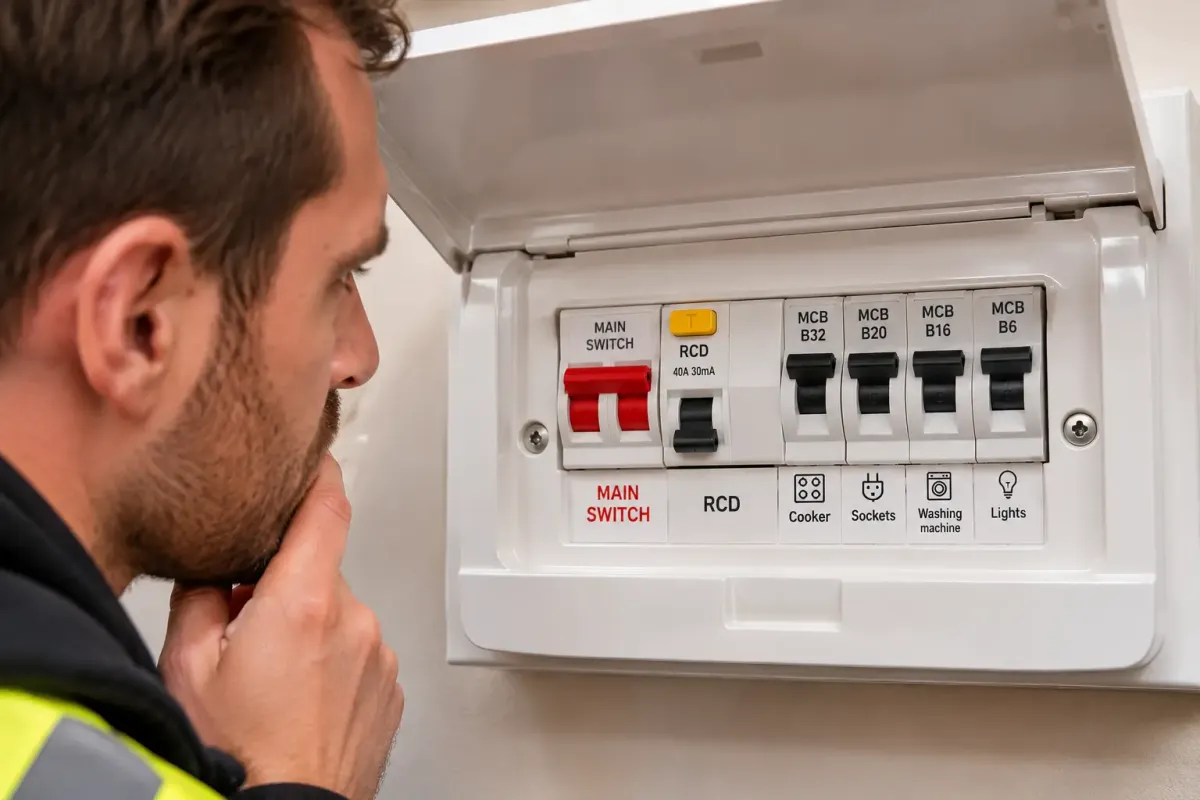
Open the door of your consumer unit and look for the switch that is down or in the off position. There are two kinds that trip, and they react to different things:
- A circuit breaker (often marked MCB) protects one circuit, such as the sockets in one part of the house or the lights. It trips when that circuit draws too much current (an overload) or when there is a short circuit.
- An RCD protects a group of circuits. It trips when electricity flows somewhere it should not, to earth, for example through a person who has touched something live. It is far more sensitive than a circuit breaker, so it is often the one that trips.
Some consumer units use RCBOs, which combine both in a single switch for each circuit. Our guide to what a consumer unit is explains each part in more detail.
Common reasons a breaker or RCD trips
The IET says that when a circuit breaker, fuse or RCD trips, the cause is most likely a fault with an appliance plugged into the installation rather than the installation itself. The usual culprits are:
- A faulty appliance. A kettle, washing machine, heater or other item with an internal fault can trip an RCD or a breaker as soon as it is switched on or runs.
- An overloaded circuit. Running too many power-hungry appliances on one circuit, or plugging one extension lead into another, can draw more current than the circuit is designed for. Electrical Safety First warns that overloading sockets this way creates a fire risk.
- A blown lamp. A lamp failing can trip a lighting circuit. This was more common with old tungsten bulbs.
- Damage to the wiring. Faults in the installation itself do happen, and the IET notes they are more likely after DIY, such as drilling into a wall to hang a picture or put up a shelf.
Safe steps to find the cause
The IET sets out a simple way to track down a faulty appliance:
- Unplug everything on the affected circuit. Take the plugs out of the sockets completely; switching off at the socket is not enough.
- Reset the circuit breaker or RCD.
- If it stays on, plug things back in one at a time. When the breaker or RCD trips again, you have found the likely cause.
- Stop using that appliance until it has been repaired.
If it trips when you plug in or switch on one particular item, the fault is almost certainly in that item rather than in your wiring.
When it won’t reset
If the circuit breaker or RCD will not stay on even with everything on that circuit unplugged, the fault is probably in the fixed wiring, a fitting, or something permanently connected such as an electric shower or an oven. That is the point to call a registered electrician. Electrical Safety First says that if the RCD in your consumer unit keeps tripping, there is likely to be a fault that needs investigating, either with an appliance or with the wiring itself.
Do not keep forcing it. The IET warns that resetting a breaker or RCD onto a fault over and over again can damage the device, so keep your attempts to a minimum. Electrical Safety First’s advice is to reset a tripped breaker only once the fault has been put right.
Warning signs you should never ignore
Get a registered electrician to check your installation if you notice any of these:
- breakers that trip or fuses that blow regularly
- burn marks on sockets, switches or plugs
- buzzing or crackling sounds, which can be a sign of arcing
- a burning smell, heat, smoke, or burning or charring at the consumer unit
For anything in that last group, the IET’s advice is to switch off the supply at the main switch straight away before you call. After a flood, Electrical Safety First says to have a registered electrician check the installation if there is any sign of water inside the consumer unit.
Test your RCDs
An RCD you have never tested may not work when you need it. Electrical Safety First recommends testing RCDs every three months. Press the button marked “T” or “Test” on each one. It should switch off the circuits it protects, and you can then switch it back on. If it does not switch off, get a registered electrician to look at it.
Finding an electrician in Surrey
The emergency electricians page lists every electrician in this directory whose website says they offer emergency or out-of-hours call-outs, ranked by Google rating and number of reviews. For a fault that is not urgent, open your town page and compare the electricians near you.
When you call, describe which switch tripped (a single circuit breaker or an RCD), whether it happens with everything unplugged, and when it started. If the electrician finds the consumer unit itself needs replacing, that is notifiable work, so ask how it will be signed off and which certificates you will receive.
Sources
- https://electrical.theiet.org/courses-resources-and-career-for-electrical-professionals/free-resources/consumer-guidance/consumer-units/
- https://www.electricalsafetyfirst.org.uk/news-and-insights/electricity-made-easy/
- https://www.electricalsafetyfirst.org.uk/safety-advice/your-questions-answered/
- https://www.electricalsafetyfirst.org.uk/safety-advice/home-and-people/house-maintenance/plugs-and-fuses/
- https://www.electricalsafetyfirst.org.uk/safety-advice/home-and-people/house-maintenance/overloading-sockets/
- https://www.electricalsafetyfirst.org.uk/safety-advice/home-and-people/older-and-vulnerable-people/